

Almost 3.7 billion people around the world are affected by oral diseases, states WHO. This is a clear indication that something is off about the individual’s oral health.
Do you think twice-a-day brushing is enough to keep up your oral health? It’s actually not!
So what’s the remedy? A pediatric dentist in San Diego says that daily practices are all that’s needed. And Ayurveda brings you the real solution by aligning your daily oral care with natural bodily rhythms. Now it’s time to preserve a vibrant, healthy smile for decades.
KEY TAKEAWAYS
- Your mouth reflects what is happening inside your body. An inflamed mouth results from too much Pitta, and receding gums indicate too much Vata.
- Three steps in the morning: scrape your tongue, pull oil, and use an herbal toothbrush to add tone to your mucous membranes and aid in natural saliva protection.
- Build bone (Asthi Dhatu) by eating good foods containing calcium (like sesame and ghee) and eliminating refined sugars, which create sludge and toxins.
- As you reach your natural Vata stage of life, prevent dehydration of your body by using oily substances and not using abrasive herbs to avoid deteriorating your structure.
- Understanding Oral Health Through the Ayurvedic Perspective
- Daily Ayurvedic Practices for Strong Teeth and Healthy Gums
- The Role of Diet in Ayurvedic Dental Wellness
- Ayurvedic Herbs Traditionally Used for Oral Care
- How Aging Can Influence Dental Health Naturally
- Lifestyle Habits That Support Long-Term Oral Wellness
- Natural Ways to Maintain Fresh Breath and Gum Health
- Building a Consistent Ayurvedic Oral Care Routine
- FAQs
Understanding Oral Health Through the Ayurvedic Perspective
When the doshas are balanced properly, the body has enough alkaline saliva, good, healthy pink gums, and shiny, corrosion-resistant teeth. If there is an imbalance in the body, this imbalance will appear quickly within one’s oral cavity.
As an illustration, if there is excessive Pitta energy in the body, then you may experience bleeding gums/inflammation.
On the other hand, if you have so much Vata energy, you may experience characteristics of receding gums, loose teeth, or a persistent dry mouth. By reading these subtle signs, you can adjust your habits to fix a problem before it turns into a painful dental emergency.
Daily Ayurvedic Practices for Strong Teeth and Healthy Gums
To have healthy gums and strong teeth, you should begin your day following a true Ayurvedic routine before putting on any toothpaste. The sages who have developed this routine have given it many steps that are performed to purify the senses and awaken your prana (or “life force”).
THE DAILY AYURVEDIC RITUAL
Each step of the ritual has its name and sequence:
- Jivha Nirlekhanam → You should begin by scraping (tongue scraping) your tongue from the back to the front to remove the coating (ama) that traps toxins.
- Kavala Graha → You swish 1 tablespoon of warm sesame oil in your mouth for 5 to 15 minutes to strengthen your jaw muscles.
- Danta Dhavana → Finally, brush your teeth using twigs or herbs such as margosa and punarnava to get the bitter and astringent taste. This process tones the more delicate mucous membranes while helping to build the natural defense mechanisms of your saliva.
This sequence doesn’t just clean your teeth; it tones the delicate mucous membranes and reinforces the natural defense mechanisms of your saliva.
The Role of Diet in Ayurvedic Dental Wellness
The real Ayurvedic morning ritual begins before you ever pick up your tube of toothpaste. Wise sages have developed a multi-step system to help purify the senses and awaken vital energy through different methods as part of their morning routine.
- The strength of your Asthi Dhatu (bone tissue) is determined by the quality and type of food you eat. To create strong teeth, highly nutritious foods that your body needs should be consumed.
- Eating a few handfuls of white sesame seeds in the morning provides an abundance of easily absorbed calcium and massages your gums.
- Green leafy vegetables, lentils, and unripe bananas can all be used to create healthy oral tissue naturally.
- Refined sugars, processed dairy products, and drinks that are heavy, frozen, or cold should be avoided or limited in your diet because they can produce a sticky and poisonous sludge in your digestive system.
- Consume ghee to lubricate the channels of your body, allowing for a smooth flow of nutrients to your jaw and teeth.
INTERESTING FACTCheck out these Ayurvedic found at home that cures dental health issues. In fact, they have anti-inflammatory properties
Ayurvedic Herbs Traditionally Used for Oral Care
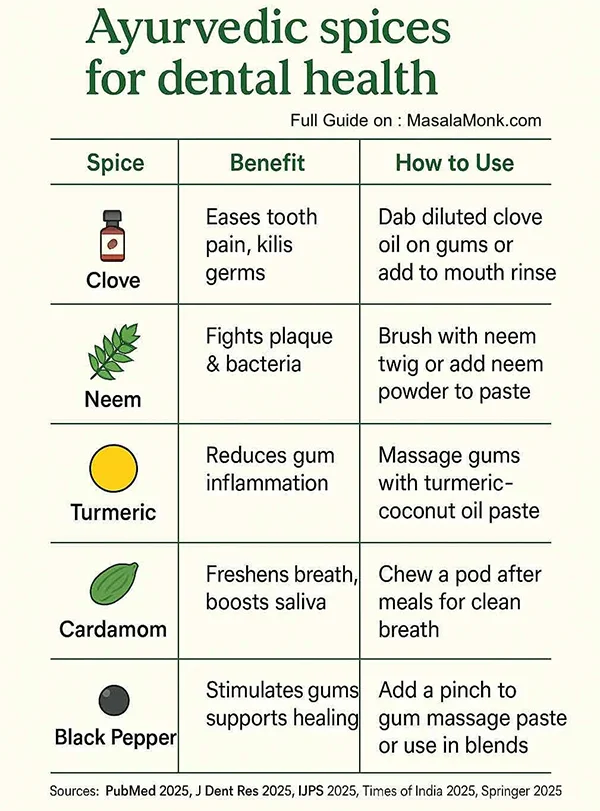
Nature provides a sprawling pharmacy specifically designed for the human mouth. For centuries, practitioners turned away from chemicals and looked toward the forest floor.
| Neem (Azadirachta indica) | The ultimate digital shield against bacteria. Its intense bitterness purifies the blood and keeps plaque from sticking to tooth enamel. |
| Babool (Acacia nilotica) | A phenomenal natural astringent that tightens loose gums and prevents accidental bleeding during meals. |
| Miswak (Salvadora persica) | Packed with natural fluorides, silica, and vitamin C, this ancient “toothbrush twig” naturally whitens teeth and freshens the breath. |
| Triphala | A magical blend of three fruits used as a warm decoction rinse to soothe mouth ulcers and reduce overall systemic inflammation. |
How Aging Can Influence Dental Health Naturally
As time goes by, your physical body goes into its Vata cycle of life—dryness, cellular degeneration. This shift has a big impact on your oral environment.
The production of saliva gradually decreases, so the mouth has less protection against acids. The moisture in your tissues is also decreasing, resulting in possible gum recession, exposing the fragile root surface.
Knowing that the dryness is just part of the cycle of nature as you age allows you to use more unctuous (wet) and warming oils, and gentle, non-abrasive herbal toothpastes. This helps keep your mouth hydrated, safe from injury, and strong.
Lifestyle Habits That Support Long-Term Oral Wellness
Oral wellness starts from both the outside and inside. You can achieve this by going barefoot outside on the wet grass in the early morning sunshine and using pranayama to get more oxygen into your blood and boost cellular repair of your gums.
Do not adopt the modern-day habit of eating and answering emails simultaneously. Mindfulness when eating by actually chewing your food is one way to fully incorporate digestive enzymes into saliva before it goes into the digestive system.
Natural Ways to Maintain Fresh Breath and Gum Health
Halitosis (chronic bad breath) is generally not a mouth issue; it is just the slow-burning or sluggish digestive fire (Mandagni) that burns in the deepest pit of your stomach. Whenever food spends more than a few minutes in your stomach, it creates a toxic gas called ama.
For the removal of this odor, you just have to implement a simple habit: reduce the consumption of alcohol-based chemical dentifrices, which kill the healthy, moist microbiome in your mouth.
I recommend chewing one or two organic fennel seeds or cardamom pods, which slowly neutralize the stomach acids, stimulate your digestive juices, and freshen your breath, at no cost.
Building a Consistent Ayurvedic Oral Care Routine
The entire journey of the digestive system begins in the oral cavity. Obviously, it plays a critical role in overall human well-being.
So what procedure can one use to keep it in good shape?
The methods are simple:
Always start with tongue scraping (Jihva Nirlekhana) to remove toxins every morning. Then immediately thereafter, move ahead towards oil pulling (Gandusha/Kavala Graha). Lastly, initiate a gum massage right before bed, after brushing and flossing, but before any antiseptic rinse.
People consider Ayurveda a treatment, but it’s actually a lifestyle. And consistency is what matters the most in every stance.
Remember, “Routine is not a cage; it is the space where healing and vitality are born.”
FAQs
Is tongue scraping needed even after brushing my tongue?
Yes, because when you only move the bacteria around instead of removing the buildup of accumulative toxic ama completely from your tongue surface.
Can I use coconut oil instead of sesame oil for oil pulling?
Yes, in hot weather, coconut oil is a good substitute for sesame for oil pulling and if you have too much Pitta energy.
Does Ayurvedic oral care eliminate the need for an appointment with my dentist?
No, the Ayurvedic method of oral care is a complement to the modern system of dental hygiene in order to obtain preventive care daily, as you have your teeth cleaned by a professional.
How quickly can I see results from oil pulling?
People generally report noticing a cleaner mouth and fresher breath within 1 week of doing oil pulling daily and experiencing improved jaw strength over several months of consistent daily.