


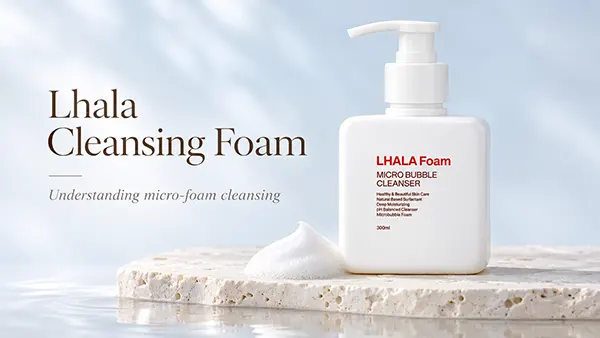
When you test a micro-foam cleanser on your skin, you should never get carried away by how great and dramatic bubbles it creates on application. These are all superficial things. Rather, your main focus should be on how well it cleans your skin of all the unwanted impurities. So, for best results, you can give Lhala Foam a try. This product will fit at the cleaning stage of your skincare routine.
For readers exploring Lhala Cleansing Foam, it is a very practical question to ask how it works and what it does to their skin. That is why we have curated this healthy skincare read for all of you!
Where Lhala Foam Fits
H2MEDI’s LHALALA product information identifies LHALA Foam as a cleanser, lists a 300 mL format, and then later describes micro-bubble cleansing and a bubble-mask application. These are product-format descriptions, rather than evidence that the cleanser produces a specific clinical improvement, to be honest. On top of that, the brand also presents the foam within a wider professional skincare system. [1]
That placement matters considerably, by the way. A cleansing product removes material from your skin surface. But a dedicated treatment addresses a different objective. Someone buying a cleanser to remove everyday oil and residue should compare cleansing performance first. Someone trying to improve persistent pigmentation or scarring needs a separate assessment of treatments for those concerns. The presence of a cleanser in a professional line does not merge those categories, if you handle this matter professionally.
Think of the cleanser as the opening step in a larger process. It should leave the face ready for the next appropriate product, without making the next step in your skincare responsible for correcting an unnecessarily harsh wash. This gives the product a useful, limited job that can actually be evaluated for better results.
Bubbles Are a Format Rather Than a Performance Score
A fine foam spreads on your face differently from a dense cream or a low-foaming gel. It offers visible coverage, changes the feel of application, and may appeal to people who enjoy a light texture. Those are legitimate reasons to prefer a format first. They are separate from a claim that smaller bubbles reach deeper into your skin surface.
The cleansing mechanism depends on the formulation, especially surfactants that help water interact with oily material easily. Reviews of cleanser science amply explain that these ingredients have water-compatible and oil-compatible regions. How they are combined together affects removal and interactions with the skin barrier. Thus, on a closer look, the size or abundance of visible foam is therefore only one feature of a much larger formulation. [2]
A useful shopping question is whether or not the foam helps you distribute the product evenly without overworking your face. A less useful question is which cleanser produces the tallest layer of bubbles for maximum cleaning. A foam can be pleasant and effective without being a stronger treatment. Likewise, a cream cleanser does not become ineffective just because of the reason that its lather is modest.
Reading the Formula by Function
The LHALALA U.S. product information publishes an ingredient list including cleansing agents, humectants, texture ingredients, botanical oils, and capryloyl salicylic acid. That list is useful for understanding a supplied version, but the label on the actual bottle remains the relevant ingredient declaration for the buyers. Regional listings should not be combined into any type of imaginary universal formula. [3]
For comparison, you should group ingredients by the work they do. Cleansing agents assist in removing residue. Humectants, like glycerin and butylene glycol are moisture-binding formulation ingredients. Texture modifiers influence dispensing, spreading, and foam structure. Fragrance-producing ingredients influence the sensory experience. This functional approach is more informative than counting botanical names or assuming that a long list means a more sophisticated wash for you.
An ingredient’s presence does not reveal its exact concentration or establish the finished product’s performance in any sense. For example, finding an exfoliating ingredient on a rinse-off label does not tell you that the cleanser delivers the same effect as a separate leave-on exfoliant on application. Contact conditions, the complete formula, and the intended usage all matter. Avoid turning one familiar ingredient into the explanation for everything a product might do when used properly.
Understanding the Published pH Range
H2MEDI lists a pH range of 5.5 to 7.5. This spans slightly acidic conditions through neutral and slightly alkaline conditions; it is not one fixed measurement and should not be described as uniformly acidic. A stated range also does not tell decisively what a different cleanser measures under the same test conditions. [1]
More importantly, pH is one comparison point rather than a complete mildness rating to be used as a conclusive factor during analysis. Surfactant systems, exposure, removal, and the user’s skin influence the overall experience. Draelos’s cleanser review discusses how cleanser chemistry and interactions with skin proteins help in explaining differences in irritation and dryness. [4]
For a buyer, the practical consequence is simple: avoid selecting a cleanser from a pH number only. A reasonable comparison asks about the whole formula and actual comfort. Two bottles with similar pH claims might behave differently, just as two similar-looking foams can leave very different after-feels.
A More Useful Way to Compare Cleansers
A product that performs well for sunscreen removal on one person’s face may feel unnecessary during a light and simple morning wash. The task changes, so the comparison should change too.
| Comparison point | Micro-foam cleanser | Cream or low-foam cleanser | What to evaluate |
| Application | Visible, airy coverage | More lotion-like or gel-like coverage | Ease of spreading without repeated rubbing |
| Cleansing strength | Depends on the complete formula | Depends on the complete formula | Removal of the residue actually present |
| After-feel | Can vary substantially | Can vary substantially | Comfort rather than a squeaky finish |
| Best reason to choose | Preferred texture with suitable performance | Preferred texture with suitable performance | Fit with skin needs and the rest of the routine |
Evaluating the Cleansing Experience
A simple assessment begins with what is on the face. A bare morning face, water-resistant sunscreen, and long-wear makeup create different removal challenges. Record the starting condition before deciding a cleanser is weak or strong. Otherwise, you may be comparing two completely different jobs and attributing the difference to the bottle.
After cleansing, consider whether visible residue remains and whether the skin feels comfortable. A very tight finish is not a useful target. The American Academy of Dermatology recommends a gentle cleanser and discourages scrubbing; it also emphasizes lukewarm water and gentle drying. Those basic habits help prevent technique from overwhelming a product comparison. [5]
For a hypothetical comparison, imagine that one cleanser removes an ordinary day’s residue comfortably, while another leaves the cheeks tight despite producing more foam. The second product has not won because its bubbles were more impressive. The relevant result is the combination of removal and comfort. If both achieve that result, texture preference and ease of use become reasonable deciding factors.
Keep the rest of the routine stable while assessing a new cleanser. Adding a new exfoliant and moisturizer at the same time makes the cause of any change harder to identify. This is a practical observation method rather than a clinical trial, but it produces better information than judging a single wash by scent and lather alone.
Packaging usability is another useful comparison point. A pump can make a foam easy to dispense, but buyers should still consider how smoothly it operates, whether the nozzle stays clean, and whether the bottle fits their storage space. For a shared professional setting, a clear product label and an orderly dispensing area also make the cleansing step easier to manage. These everyday details can matter more than an elaborate description of the bubbles.
Common Misreadings of Micro Foam
The first mistake is equating bubbling with oxygen delivery to deeper skin. Visible bubbles are not proof of a change in tissue oxygenation. The second is treating a rinse-off cleanser as an intensive peel because both products appear in the same range. Each has its own intended role, and the products should be understood separately.
A third mistake is assuming plant-derived ingredients make a formula automatically suitable for every person. Ingredient origin describes a source, not an individual response. Someone who already knows a particular fragrance or botanical ingredient disagrees with their skin should read the bottle accordingly.
Finally, do not reward a cleanser for making the skin feel stripped. A polished routine does not require an uncomfortable starting point. Choose a wash for its actual contribution, then give moisturizer, sunscreen, and any selected treatments their own clear jobs.
Choosing a Cleanser With a Clear Purpose
When comparing skincare products from FillersFairy, keep cleansing separate from the promises attached to the wider routine. Ask for the current product information and compare the foam’s format with your actual removal needs. A well-chosen cleanser earns its place by doing that straightforward job consistently and comfortably.
Frequently Asked Questions
Is Lhala Foam the same product as Lhala Peel?
No. LHALA Foam is the cleanser in the product family. A peel is a separate treatment product with its own purpose and directions. Sharing a brand does not make the products interchangeable or give them the same expected outcomes.
Does micro foam mean stronger cleansing?
Not by itself. Cleansing depends on the complete formulation and what needs to be removed. Visible foam helps describe texture, but it does not quantify makeup removal, skin-barrier effects, or performance against another finished cleanser.
Should skin feel tight when the cleanser has worked?
Tightness is not a required sign of successful cleansing. Look for removal of unwanted residue together with a comfortable after-feel. Repeatedly washing until the face feels squeaky can make the routine less pleasant without answering the underlying removal problem.
Can a bubble-mask format replace the next treatment step?
No. The manufacturer describes a bubble-mask use, but that does not make the cleanser equivalent to an exfoliating treatment or leave-on serum. Follow the supplied directions rather than extending contact time to chase an assumed stronger effect.
What is the most useful information to check on the bottle?
Start with the exact product name, ingredient list, directions, and format. For personal compatibility, the ingredient declaration is more useful than a broad phrase such as professional quality. Then judge whether the product performs the cleansing job comfortably.