

There are high chances that you’ve walked past a small tin of white paste at a paan shop a hundred times without giving it a second thought. That paste is chuna, and for most of us, it’s just “the thing that goes on the betel leaf.” No one talks about it. Nobody Googles it. It doesn’t have a glossy Instagram page or a celebrity endorsing it.
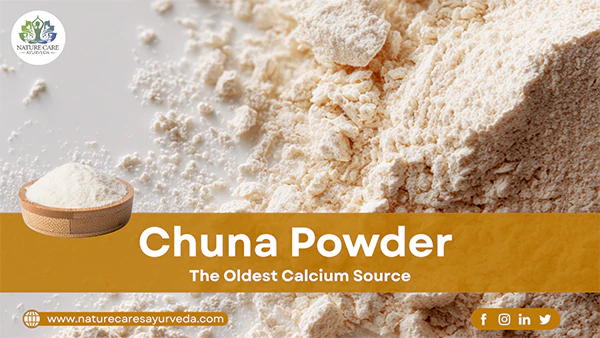
And yet, this white paste is one of the oldest calcium sources known to Indian households. It is used, generation after generation, long before anyone had heard the word “supplement.”
Here in this blog, I want to bring chuna out of the paan tin and into the conversation it deserves, because once you understand what it actually is and how our ancestors used it, you start looking at your kitchen shelf a little differently.
Quick Answer
Chuna (edible lime) is traditionally used in Ayurveda as a natural source of calcium that may support bone and dental health, aid digestion, and promote overall wellness when consumed in very small, recommended amounts. However, only food-grade edible chuna should be used, as excessive intake may cause side effects.
- What Exactly Is Chuna?
- Chuna in English – What Are We Actually Talking About?
- Edible Chuna vs. Chuna Used in Construction
- Chuna Powder: Form, Texture, and Traditional Preparation
- Chuna Benefits According to Ayurveda
- Why Your Grandmother's Paan Habit Wasn't Just a Habit
- How Much Chuna Is Safe to Consume?
- Who Should Avoid It
- Bringing Chuna Back Into a Balanced Ayurvedic Lifestyle
- FAQs
What Exactly Is Chuna?
Chuna is a mineral preparation made by heating limestone until it breaks down, then slaking it with water. What comes out the other end is a soft, white, alkaline paste or powder, mostly calcium hydroxide, with trace minerals depending on the source rock.
It’s been used across South Asia for centuries, not just as food, but in whitewashing walls, in traditional construction, and the part we care about here, as a digestive and skeletal tonic when prepared and consumed correctly.
The important distinction is that not all chuna is meant to go anywhere near your mouth. There’s a construction-grade version and a food-grade version, and the two are not interchangeable.
Chuna in English – What Are We Actually Talking About?
If you’ve ever tried explaining chuna to someone outside India, you’ll know the confusion begins with the name itself. Chuna in English is most accurately translated as slaked lime, sometimes also called hydrated lime. Chemically, it’s calcium hydroxide.
You may also see it referred to simply as edible lime when it’s specifically the food-safe version meant for internal consumption not to be confused with the citrus fruit that shares the same English name.
This naming overlap trips a lot of people up when they’re searching for information online, so it’s worth remembering: the lime in chuna has nothing to do with lemons or citrus. It’s a mineral, not a fruit.
Edible Chuna vs. Chuna Used in Construction
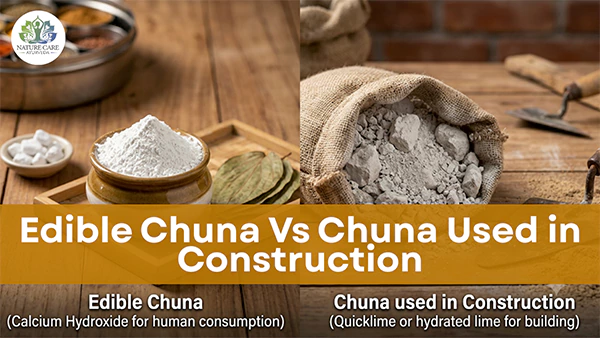
This is the one point I’d ask you to take seriously. Edible chuna is manufactured and purified specifically for consumption. It’s food-grade, refined, and traditionally prepared in small batches for use in paan, pickles, or Ayurvedic formulations.
The chuna sold for whitewashing walls or mixing into mortar is a completely different product, often with impurities, heavy metals, or additives that have no business being anywhere near your digestive system.
If you’re buying chuna to eat, buy it from a trusted Ayurvedic or food supplier who explicitly sells the edible variety. This isn’t a place to improvise with what’s lying around a hardware store.
Chuna Powder: Form, Texture, and Traditional Preparation
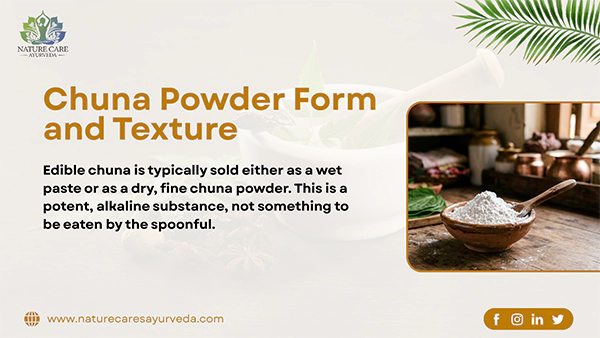
Edible chuna is typically sold either as a wet paste (the kind you see smeared onto a betel leaf at a paan counter) or as a dry, fine chuna powder. The powder form is easier to store, measure, and mix into other Ayurvedic preparations like herbal churnas, gulkand-based blends, or honey mixtures.
Traditionally, it’s kept in small quantities because this is worth repeating, a little goes a long way. This is a potent, alkaline substance, not something to be eaten by the spoonful.
Chuna Benefits According to Ayurveda
Ayurveda classifies chuna as ushna (heating) in potency and considers it deepana (digestive-stimulating) and balya (strength-promoting) when used in the correct micro-dose. Here’s where the real chuna benefit lies for Ayurveda for beginners:
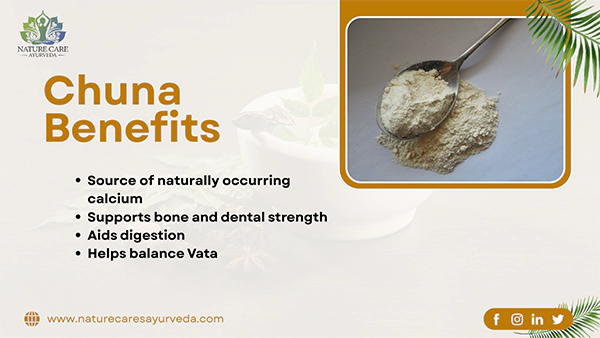
- A source of naturally occurring calcium: Unlike synthetic calcium tablets, often made from calcium carbonate or calcium citrate, the calcium hydroxide in chuna is considered more readily assimilated by the body when taken with the right accompaniments. Synthetic supplements are frequently associated with poor absorption, constipation, and even mineral buildup in the kidneys over time when taken carelessly.
- Supports bone and dental strength: In traditional practice, chuna in small quantities has long been associated with supporting bone density and tooth strength, which is part of why it found its way into everyday rituals rather than being locked away as a “medicine.”
- Aids digestion when combined correctly: On its own, chuna is intense. But paired with warming, balancing ingredients like elaichi, gulkand, or betel leaf, it becomes part of a formulation that traditionally supported healthy digestion after meals, which is precisely the logic behind the after-dinner paan ritual. It is believed to be one of the natural remedies for stomach gas and acidity.
- Helps balance Vata: Because of its warming nature, chuna in small doses has traditionally been used to pacify Vata dosha, which governs movement, joints, and the nervous system, one reason it shows up in formulations aimed at joint and bone health.
Why Your Grandmother’s Paan Habit Wasn’t Just a Habit
Here’s the part that always gets me. We tend to write off old family rituals as “just cultural habits” , the after-dinner paan being a classic example. But look closer, and you’ll see it’s a small piece of functional medicine disguised as tradition.
A pinch of chuna, a smear on a betel leaf, a touch of gulkand to cool its heat, some cardamom and areca nut to stimulate digestive enzymes, none of this was random.
Betel leaf itself has natural antibacterial properties, gulkand balances the heating effect of the lime, and the areca nut and cardamom support digestive fire. Put together, it’s a formulation, not a snack.
Somewhere along the way, as fast food and synthetic supplements took over Indian kitchens, this everyday ritual got reduced to “paan is bad for your teeth”, without anyone pausing to ask why it existed in the first place.
How Much Chuna Is Safe to Consume?
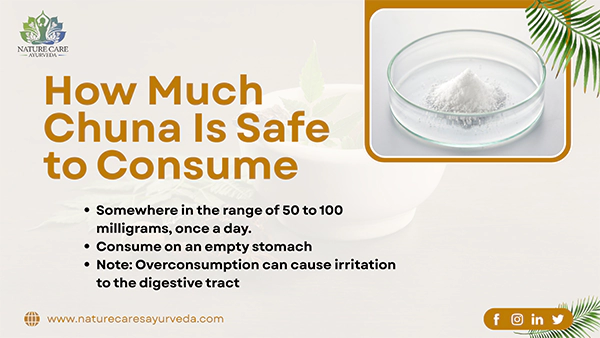
This cannot be stressed enough: chuna is not a “the more, the better” ingredient. Traditional Ayurvedic use limits the dosage to roughly a grain-sized pinch, somewhere in the range of 50 to 100 milligrams, once a day.
It’s typically taken in one of two ways:
- Mixed into gulkand or honey and consumed on an empty stomach
- Applied in a thin smear inside a betel leaf along with cardamom, chewed after meals
Overconsumption can cause irritation to the digestive tract, so this is a case where “natural” absolutely does not mean “unlimited.”
Who Should Avoid It
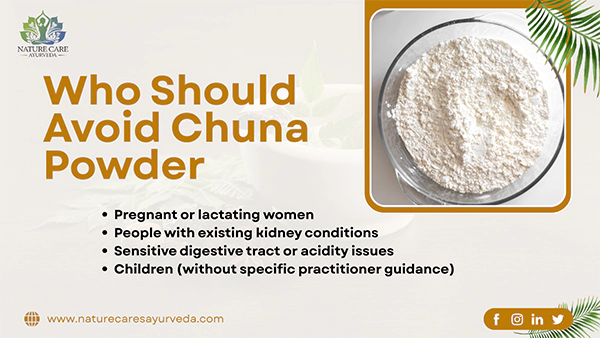
Chuna isn’t for everyone, and self-experimentation isn’t advisable here. It’s generally best avoided, or used only under expert guidance, by:
- Pregnant or lactating women
- People with existing kidney conditions
- Anyone with a sensitive digestive tract or acidity issues
- Children, without specific practitioner guidance
If you’re managing any chronic condition, please don’t add chuna to your routine without speaking to a qualified Ayurvedic practitioner first. This is one of those ingredients where the dose truly makes the difference between a tonic and an irritant.
Bringing Chuna Back Into a Balanced Ayurvedic Lifestyle
At NatureCares Ayurveda, we keep coming back to one simple idea: the body responds better to what it recognizes. A mineral like chuna, used the way it’s been used for centuries, in small, considered amounts, alongside complementary herbs, sits far more comfortably with our digestive systems than a synthetic tablet manufactured in a lab.
If bone health and digestion are on your mind, chuna doesn’t have to work alone. It pairs well within a broader Ayurvedic routine, think of how Triphala supports digestion and gut balance, or how understanding your Pitta dosha can help you decide whether a warming substance like chuna suits your constitution in the first place. And if you’re only just getting familiar with how Ayurveda approaches the body as a whole, our guide on what Ayurveda actually is is a good place to start before adding anything new to your routine.
References –
How to use Chuna – Times Of India
FAQs
Q1: Is chuna the same as the lime you use in cocktails?
Ans: No. This is the most common mix-up. Chuna in English translates to slaked lime, a mineral compound (calcium hydroxide) completely unrelated to the citrus fruit.
Q2: Can I eat construction-grade chuna if I can’t find the edible version?
Ans: No, never. Construction-grade lime is not purified for consumption and may contain harmful impurities. Only use products explicitly labelled as edible chuna or edible lime.
Q3: What does chuna powder taste like?
Ans: It’s sharply alkaline and slightly bitter on its own, which is exactly why it’s traditionally paired with sweet or cooling ingredients like gulkand rather than eaten plain.
Q4: Is daily consumption of chuna safe long-term?
Ans: In the tiny, traditional micro-doses described above, it has been used daily for generations. But long-term daily use should still ideally be guided by an Ayurvedic practitioner, especially if you have any underlying health conditions.
Q5: Where can I buy authentic edible chuna?
Ans: Always source it from a trusted Ayurvedic or specialty food supplier that clearly labels the product as food-grade, rather than a general hardware or construction supplier.