


Coughing can feel self-limiting if it persists for weeks. It is the spontaneous physiological reaction of our immune system to protect itself from pollutants and infections. However, when there is no or little mucus or phlegm, the throat dries out. This results in an unproductive cough or dry cough.
Thankfully, there are many Ayurvedic home remedies for dry cough. They are observed to be highly effective among the patients. Let’s discuss everything you need to know about dry cough and its treatment through Ayurveda!
| Did You Know? A cough that lasts for about 3 weeks is considered an acute or short-lived cough. If it persists for more than eight weeks, it is regarded as a chronic or persistent cough. |
Causes and Symptoms of the Dry Cough

An unproductive cough brings a very tormenting experience. It can feel like a tickling sensation in the throat, along with chest tightness. It is important to learn about its symptoms and causes before moving on to the dry cough remedies.
Causes of the Dry Cough
To cure this issue, you must first know the root causes:
| Causes | Description |
| Postnasal Drip | Postnasal drip is also known as upper airway cough syndrome. In this condition, extra mucus drips down your throat because of a cold or seasonal allergies. It can trigger a non-productive cough or a cough with some mucus. |
| Asthma | Asthma is a disease in which the airways swell up and become narrow. Coughing is one of the symptoms of Asthma, along with others like chest pain and shortness of breath. However, there is a type of asthma where coughing is the only symptom. It is called Cough Variant Asthma (CVA). |
| Acid Reflux or GERD | Acid Reflux or GERD is a condition where the acid in the stomach flows up to the oesophagus. The acid can be harmful to the oesophagus and trigger unproductive coughs. Here, coughing occurs as a protective reaction to prevent the acid from entering the lungs. |
| Upper Respiratory Infection | Upper respiratory infection affects the upper respiratory system, including the nose, voice box (larynx), throat, and pharynx. One of the most frequent examples of URI is the common cold and Flu. It is a contagious viral or bacterial illness that can trigger unproductive coughs. |
| Viral Infection | Viral infections are the most prevalent causes of an unproductive cough. Whenever you come in contact with any viruses and get a common cold, the short-term symptoms usually last for less than 7 days. However, your airway gets irritated through this, and it results in post-cold dry coughs. |
| Allergies | Whenever our body detects any dangerous foreign particle, such as dust or pollen, it tends to attack it. This leads to coughing, which can be accompanied by other allergic symptoms. Other symptoms may include a runny nose and itchy eyes. |
Symptoms of the Dry Cough
Unlike the productive or wet cough, unproductive coughs don’t involve the clearance of mucus and lead to persistent irritation. There are many symptoms that you can identify if it is a dry cough:
| Common Symptoms of Dry Cough No production of mucus when you cough.A continuous tickling sensation in the throat that doesn’t go away.A discomfort that something is stuck in the throat.Possible wheezing and increased breathlessness.A hacking cough that is causing muscle aches and increased irritation. |
Effective Ayurvedic Home Remedies For Dry Cough
With the remedies mentioned below, such as ginger tea, marshmallow lozenges, and a turmeric and black pepper beverage, you can experiment and find the right solution for you. Let’s see them in detail:
Herbs and Dietary Supplements
Many herbs and the right Ayurvedic supplements are traditionally observed to be effective in the treatment of dry cough. Some of them are:
- Honey

Honey has antimicrobial and anti-inflammatory properties that work best to soothe the throat. It coats the throat, relieving irritation and soreness. According to the study conducted by the National Center for Biotechnology Information, honey is one of the most used Indian home remedies for dry cough in children above the age of 1.
Honey can be consumed in various ways. You can consume a spoonful directly whenever you experience a coughing bout, or it can also be mixed with warm water or tea according to taste preference.
Note: Avoid giving honey to children below the age of 1. It can cause a rare condition of infant botulism.
- Ardraka (Ginger)

Ginger is a highly beneficial anti-inflammatory and anti-bacterial ayurvedic remedy for dry cough. In Ayurveda, it is believed that it restores energy and immunity naturally.
It can be used in multiple ways to soothe an irritated throat. One of the most common ways is to use ginger in a tea. Add honey to the tea, and it will be even more effective and taste better.
- Haridra (Turmeric)

Traditionally, turmeric is found to be highly effective in the treatment of sore throat and non-productive cough. It contains curcumin that is anti-viral, anti-inflammatory, and anti-bacterial, decreasing inflammation and soothing irritation in the throat.
This substance can be combined with Trikatu (long pepper, black pepper, ginger), ghee and sugar for better absorption in the body. The mixture is known as Haridrakhanda in Ayurveda. Mix 1 or 1/2 teaspoon of Haridrakhanda with warm water or milk. Drink 2-3 times a day to see better results.
- Tulsi (Holy Basil)
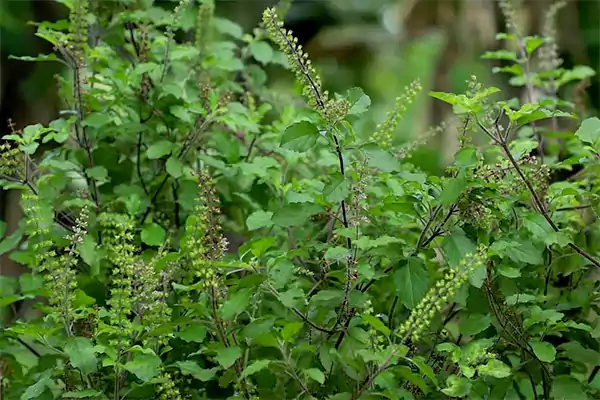
Tulsi is highly effective in the treatment of dry cough. It has antitussive, anti-inflammatory, and soothing properties. Tulsi consumption supports immune health and reduces throat irritation.
The herb can be consumed in many forms. The most common one is having it in the form of a tea. To make tulsi tea, boil 10-15 fresh tulsi leaves in a cup of water. Strain the leaves, add honey or sugar as per your preference and sip warm.
- Yashtimadhu (Mulethi)
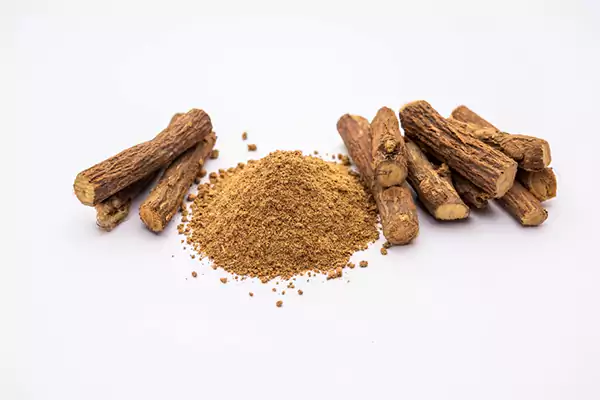
Yashtimadhu (Mulethi) is believed to be a natural Ayurvedic remedy for the treatment of dry cough and sore throat. It contains glycyrrhizin that has anti-inflammatory properties and supports easy breathing. You can chew raw mulethi sticks or drink boiled mulethi water (kadha) according to your preferences.
Making mulethi kadha is a very easy task. Boil 1-2 teaspoons of mulethi powder or small sticks in 2 cups of water for 10 minutes. Strain and sip warm. Ginger and honey can also be added for extended benefits.
- Khatmi (Marshmallow Root)
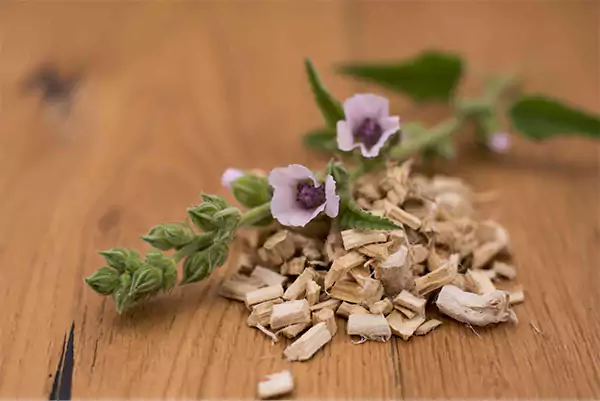
Khatmi (marshmallow root) is one of the beneficial home remedies for a dry cough at night and contains mucilage that acts like a protective layer in your throat and provides relief.
It is highly beneficial as a component for lozenges and cough syrup for dry cough in adults. You can also make tea by steeping marshmallow root in hot water.
- Masala Chai

A well-brewed cup of masala chai is a favourite beverage of Indians. It is considered one of the best home remedies for a dry cough and sore throat. Along with being a versatile beverage, Masala Chai is considered anti-inflammatory and anti-fungal.
Making a cup of masala chai is a very easy task. It’s a blend of black tea with milk and some spices like cinnamon, cloves, cardamom, and grated ginger. For a sweetener, you can use sugar or honey as per your taste preferences.
- Peppermint

Peppermint has cooling and pungent properties that balance kapha and pitta dosha. It is another one of the widely used dry cough remedies. It contains methanol, which numbs the nerve endings in the throat. This results in instant pain relief in bouts of cough.
Many people prefer having peppermint tea or lozenges before going to bed.
Other Dry Cough Remedies
Besides the herbs and dietary supplements, there are many tried-and-tested dry cough remedies that you can embrace in your daily lives. Such as:
- Lukewarm Salt Water Gargle
Salt water gargles soothe the nerve endings in the throat and decrease inflammation. Add 1/2 teaspoon of salt to a glass of lukewarm water. Take a sip, gargle for 30 seconds, and spit it out. Repeat a few times a day for faster results.
Note: Saltwater gargles are not advised as a suitable home remedy for a dry cough in babies or young children. They might swallow the water that can lead to complications like nausea and upset stomach.
- Humidifier
There is a possibility that a dry cough gets worse in dry air. A humidifier is a machine that is used to add moisture to the air. This is especially beneficial for opening up sinuses.
If your home has dry air, consider installing a humidifier. It helps in easy breathing.
- Aromatherapy with Eucalyptus
Aromatherapy refers to the practice of breathing in essential oils to soothe and recover. Eucalyptus is a type of essential oil that is regarded as helpful in non-productive coughs.
There are many ways to use eucalyptus; you can add it to a diffuser or an inhaler. It can also be applied directly to the body. The oil not only boosts immunity but also saves you from infections.
- Airpurifier
Airpurifiers are used to get rid of dust and smoke-related airborne diseases or allergies. They are functional in reducing the dander or pollen allergens.
Breathing purified air helps with throat discomfort and reduces the need to cough.
- Antitussive Cough Syrup
Antitussive cough syrup is an OTC medication. It works on diminishing the cough reflex. This cough syrup is very helpful if the non-productive cough is very painful and disrupts sleep.
These syrups are easily available in the market. It contains ingredients like camphor, menthol, and dextromethorphan.
Quick Tips for Instant Relief
|
Scientific Research and Findings on Dry Cough Remedies
Over the years, modern science has been exploring the history and principles of Ayurvedic medicine. There are many recent studies conducted to discover more about Ayurvedic home remedies for dry cough and sore throat.
Some of the scientific research is mentioned below:
| Study Year: 2018 Aim: To create a better documentation of the user impression of the effectiveness and tolerability of cough preparations containing aqueous marshmallow root extracts. Method: Consumers bought either lozenges or syrup of the aqueous marshmallow root extract in two surveys. After 7 days of treatment, they were asked to fill out a questionnaire. Key Findings: The results of these two surveys justify the use of marshmallow root in the treatment of dry cough. Source: National Center of Biotechnology Information |
| Study Year: 2021 Aim: To assess the impact of a ginger and honey mixture for the treatment of dry cough in children. Method: Included 100 patients who attended the pediatric OPD complaining about a dry cough. Asked them to answer a questionnaire about the severity of the dry cough. Divided them into four groups and offered standard treatment and a honey and ginger mixture. Results: It is found that ginger and honey treatment needed less recovery time. There was no occurrence of sedation and drowsiness as compared to dextromethorphan. Source: International Journal of Basic & Clinical Pharmacology |
Wrapping Up
Dry cough has been one of the most common complaints among patients. It always brings a lot of discomfort and irritation. Most of the unproductive coughs resolve on their own. However, if they are not going away, the Ayurvedic home remedies restore energy and immunity naturally in such cases.
The regular use of ginger honey tea, haridrakhanda milk, salt water gargles, and OTC medications usually proves to be beneficial in providing quick relief. Though if the cough persists for more than 2 months, it is recommended to see a doctor.
FAQs
Q1: What is the fastest way to cure a dry cough?
Ans: The home remedies work effectively to provide a quick fix to dry cough. Try salt water gargles, sip honey water, and sit in warm baths. These practices help in soothing the throat and reducing the desire to cough. However, if coughing gets worse, it’s advised to see a doctor.
Q2: How do I stop a dry cough at night?
Ans: There are many beneficial home remedies for a dry cough at night. For instance, you can try peppermint tea, marshmallow root syrup, or lozenges and salt water gargles. They help you prevent nighttime awakenings and have a comfortable sleep.
Q3: Is there any Ayurvedic medicine for dry cough available by Patanjali?
Ans: Yes! Patanjali offers many medicines for non-productive coughs. Some of the most used are Patanjali cough syrup, Divya Swasari Pravahi, and Patanjali Coronil Tablet. Always speak to the doctor about the dosage and timings before starting the medication.
Q4: How effective are Ayurvedic remedies for dry cough?
Ans: For seeing results in Ayurveda supplements and remedies, the key is to be consistent and patient. The continuous use of masala chai, honey, and peppermint can bring peaceful sleep and breathing ease.
In many Indian households, these treatments are common.
Q5: Should I take any specific diet for dry cough treatment?
Ans: Yes! There are many changes in diet that you can look out for. You can include boiled vegetables, dates, and veg soup in your daily meals. Speak to the doctor regarding the right diet for the treatment.